Why Some Women Over 55 Are Rethinking the 3 PM Coffee
The afternoon cup is one of the most reliable rituals in American life. So what is landing beside it, and why does it come from the Himalayas?

It’s 2:47 in the afternoon. You’ve read the same email three times and the words still won’t land. Your eyelids are heavy, your patience is thin, and the only thing standing between you and the rest of the day is the coffee maker. Again.
If you’re a woman over 50, you know this moment better than you’d like to admit. And if you’re honest, it isn’t only about 3 PM.
- Your internal clock builds in a natural dip in alertness in the early afternoon, and researchers have found it shows up even in people who skip lunch.8
- Around menopause, which the average American woman reaches at 52,11 estrogen falls steeply, starting roughly two years before the final period.10
- In one controlled study, caffeine taken a full six hours before bed still measurably cut total sleep time.5
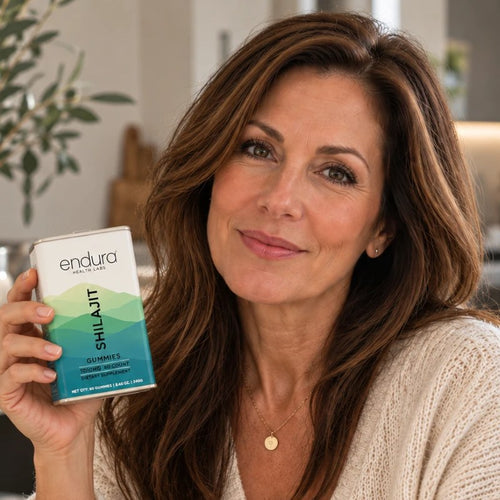
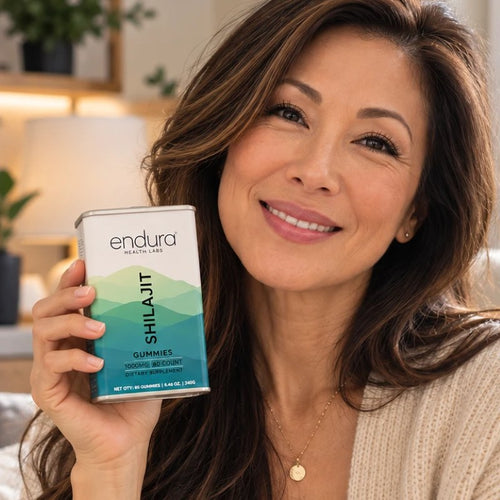
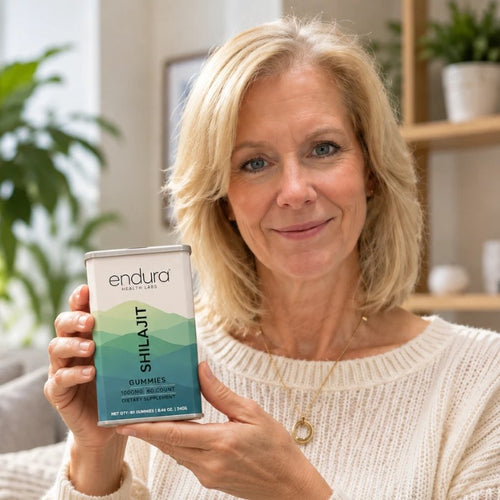
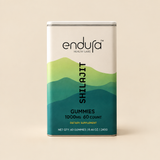
- Endura carries purified shilajit in a daily blend gummy that takes three seconds. It is not a treatment for menopause or for tiredness caused by a medical problem.
The part nobody talks about
It’s waking at 3 AM, hot and wired, staring at the ceiling while your mind rewrites tomorrow’s to-do list. It’s walking into a room and forgetting why. It’s snapping at someone you love and not quite recognizing the voice that did it. It’s catching your reflection in a shop window and seeing a woman more tired than you feel you have any right to be.
Your mother probably never talked about it. Your doctor may have given it seven minutes. And the world mostly carries on as if women quietly stop mattering somewhere around 55.
Which of these sound like your week?
Tap all that apply and we’ll tailor the rest of this article to you. Nobody else sees your answers.
Your answers stay on this device.
None of this means something is wrong with you. It means your body is now running on a different set of rules than it did at 35, and almost nobody explains them. So let’s.
Why we wrote this
We are Endura Health Labs, and we are paying for this article, so read it with that in mind. We wrote it because the 3 PM slump is one of the questions women over 50 ask most, and because you deserve the whole picture: what the research shows, where it runs thin, and what you can do about it whether or not you ever buy anything from us.
Every claim below carries a numbered source at the bottom of the page. Where the evidence is early, we say so.
What is really happening at 3 PM
Two things collide in the early afternoon. Cortisol, the hormone that gets you moving in the morning, peaks shortly after you wake and slides downhill all day. At the same time, your internal clock builds in a natural dip in alertness in the early afternoon. Researchers have found it shows up even in people who skip lunch entirely.8
Why 3 PM hits so hard
Cortisol, the hormone that gets you going, peaks shortly after you wake and slides downhill all day. Your body clock adds its own dip in alertness in the early afternoon, even if you skip lunch.
Illustrative curves based on Monk 2005 and Van Cauter 1996.8,9
In your twenties, that dip is a speed bump. After 50, it can feel like driving off a ledge, and there is a reason for that.
The change that rewires everything
Around menopause, which the average American woman reaches at 52,11 estrogen does not fade politely. In the largest long-term study of the transition, it held fairly steady until roughly two years before the final period, then fell steeply.10 Estrogen has a hand in sleep, body temperature, mood and focus, so when it drops, a lot of things shift at once. Often in the same year.
The hormone drop nobody warns you about
SWAN, a study that followed more than 3,000 women through menopause, found estrogen held fairly steady until about two years before the final period, then fell steeply. The average American woman reaches menopause at 52.
Randolph et al. 2011 (SWAN); National Institute on Aging. Curves are illustrative.10,11
Then there is the stress hormone itself. When researchers measured cortisol around the clock in healthy adults, average levels rose 20 to 50% between age 20 and age 80, and the night-time low point crept higher with every decade.9 In plain English, the body’s “off switch” at night gets weaker. It is one reason so many women describe feeling exhausted all day and wired all night.
Your stress hormone doesn’t switch off like it used to
When researchers tracked cortisol around the clock in healthy adults, the night-time low point crept higher with every decade, in women and in men.
Van Cauter, Leproult and Kupfer 1996. Curves are illustrative.9
And sleep pays the price. Reported sleep problems climb through the menopause years, reaching as many as six in ten women after menopause.12
3:12 AM, wide awake
Reported sleep problems climb through the menopause years. After menopause, up to six in ten women say they are affected.
Ranges of reported prevalence from SWAN data, summarized by Lee et al. 2019. Each bar spans the reported range.12
The 3 PM question
The afternoon cup has a job, and everyone knows what it is. What fewer people talk about is the fine print: the second or third coffee of the day arrives closer to bedtime than the first, and caffeine is caffeine whenever you drink it. One controlled study found that caffeine taken a full six hours before bed still measurably cut total sleep time.5 For a body whose sleep is already more fragile, that matters.
So the question is not “should I stop drinking coffee?” The question is smaller: is there something else worth reaching for at 3 PM, something that feels like a ritual and does not come with a caffeine label?
A resin from the rocks
That question is how a lot of women first come across shilajit, a dark, tar-like substance that seeps from rock in high mountain ranges, most famously the Himalayas. It forms over a very long time from compressed plant matter and minerals, and it has a long history of traditional use in Ayurveda, the traditional medicine system of India, where classical texts describe it as a rasayana, a substance taken to support general wellbeing.6
Raw shilajit, though, is not pleasant. It is sticky, it stains, and it is famously bitter, with an earthy, smoky flavor most first-timers describe with a wince. You have to measure a pea-sized amount, dissolve it, and drink it down. For something meant to be taken daily, that is a lot of friction.
The daily-blend idea
What changed was the format. Blended with vitamin D3 and 15 more ingredients into one gummy, purified shilajit takes three seconds. It sits in a dish on the counter. It does not need a kettle, a spoon, or a strong stomach. For women who liked the idea of a 3 PM pause but did not love what the third coffee was doing to their evening, the ritual was the part they wanted to keep. The cup was replaceable.
The next 30 years start now
Here is the part that should make every woman over 50 sit up. The habits you settle into now are the ones you will be living with at 75.
The muscle clock starts at 30
Adults lose roughly 3 to 8% of their muscle mass every decade after 30, and the pace picks up after 60. Muscle is what gets you up the stairs, carries the groceries and lifts you off the floor at 80.
Volpi, Nazemi and Fujita 2004. Curve is illustrative, using a mid-range rate.14
Muscle quietly declines from 30 onward, and faster after 60.14 Skin makes far less vitamin D from sunlight as it ages.13 Sleep gets more fragile. None of this is destiny, but all of it rewards the women who act early rather than late.
Before you buy anything, ask your doctor
Whatever you decide about any supplement, these are worth a conversation at your next appointment. Any good doctor or pharmacist will be glad you asked.
1. “Is my vitamin D level where it should be?” A simple blood test answers it.
2. “Does anything I take, or any condition I have, mean I should avoid a new supplement?” This matters most if you take prescription medication.
3. “Could my sleep, energy or mood changes have a cause we can treat?” Menopause options, thyroid and iron levels are all worth ruling in or out.
4. “Which strength and walking habits make sense for me?” Of everything in this article, this is the habit with the strongest evidence behind it.
Answer the 20-second check near the top of this article and we’ll put the research and the steps most relevant to you right here.
Take the check ↑Your plan
Based on your answers: what is often behind each one, what genuinely helps, and where we honestly fit (and where we don’t).
Afternoon energy
- What’s often behind it
- A dip in alertness in the early afternoon is built into your body clock, and it shows up even in people who skip lunch.8 Tiredness that won’t lift can also have medical causes, such as anemia or medication side effects, that are worth ruling out.35
- What helps
- Regular physical activity such as walking, and short naps.35 Two strength sessions a week to protect muscle, which declines faster after 60.14
- Where Endura fits
- A three-second, caffeine-free afternoon ritual to take the place of the late coffee, since caffeine even six hours before bed measurably cut sleep in a controlled study.5 It won’t fix tiredness, and we don’t claim it does.
Sleep
- What’s often behind it
- Reported sleep problems climb through the menopause years, reaching as many as six in ten women after menopause.12 The body’s night-time cortisol low also creeps higher with every decade.9
- What helps
- Keep caffeine out of the afternoon: caffeine taken six hours before bed still cut total sleep time.5 If you snore or wake gasping, ask your doctor about sleep apnea; blaming every sleep problem on menopause can leave it undiagnosed.36
- Where Endura fits
- It is caffeine-free, so it can stand in for the afternoon coffee without touching your night. It is not a sleep aid.
Feeling wired or on edge
- What’s often behind it
- Average cortisol rises 20 to 50% between age 20 and 80, and the night-time low creeps higher.9 In a controlled trial, caffeine raised cortisol across the waking day.21
- What helps
- Exercise with recovery built in, since very hard sessions push cortisol up,22 less caffeine later in the day, and a daily wind-down you actually keep.
- Where Endura fits
- No caffeine to add to the afternoon. Our formula has 30mg of ashwagandha, far below the 600mg a day used in a stress study,23 so we make no stress claim for it.
Brain fog and lost words
- What’s often behind it
- In a large study of midlife women, learning and memory scores dipped during the menopause transition and recovered afterwards.32 Broken sleep makes any fog worse.
- What helps
- Protect your sleep, move every day, and tell your doctor if it is getting worse rather than better.
- Where Endura fits
- We make no memory or focus claim. What it offers is a caffeine-free afternoon habit that leaves your sleep alone.
Stiffness and strength
- What’s often behind it
- Muscle declines from 30 and faster after 60,14 bone loss speeds up around the final period,31 and older skin makes far less vitamin D from sunlight.13
- What helps
- Two strength sessions a week,14 protein at every meal, and asking your doctor about a bone density scan and a vitamin D blood test.
- Where Endura fits
- 20mcg of vitamin D3 per serving, 100% of the Daily Value. Vitamin D is needed for healthy bones and normal muscle function,3 and D3 raises blood levels more effectively than D2.17
Hot flashes and night sweats
- What’s often behind it
- They are a hallmark of the menopause transition, and they last longer than most women expect: a median of 7.4 years in a US study of 3,302 women.29
- What helps
- Hormone therapy remains the most effective treatment for hot flashes and night sweats,30 and there are non-hormonal prescription options too. Ask your doctor which suits you.
- Where Endura fits
- It doesn’t. Endura does not treat hot flashes, and supplements have not been clearly shown to.34 Your doctor is the right first stop.
Not feeling like yourself
- What’s often behind it
- Many things at once: broken sleep, the hormonal shifts of midlife, and everything life is asking of you right now.
- What helps
- A proper conversation with your doctor. Low mood is common, it is treatable, and it deserves more than seven minutes.
- Where Endura fits
- It doesn’t. Endura is not a treatment for mood, and we won’t pretend otherwise.
Your sleep
- What’s often behind it
- In a study of 106 couples, 27% of Parkinson’s partners reported frequent sleep disturbances, and their sleep tracked with his symptoms and his nights.41
- What helps
- Tell his neurologist about the nights; the researchers suggested better treatment of his symptoms may help your sleep too.41 Keep caffeine out of the afternoon.5
- Where Endura fits
- It is caffeine-free, so an afternoon habit won’t cost you the sleep you do get. It is not a sleep aid.
The mental load
- What’s often behind it
- Researchers call it caregiver burden, and a review warns that when it goes unrecognised it can lead to burnout.40
- What helps
- Caregiver education and support programs measurably reduced burden and depression in a review of 78 studies.43
- Where Endura fits
- It doesn’t. Nothing in a tin lightens this; support does.
Your own health
- What’s often behind it
- One in four caregivers says it is hard to look after their own health.44
- What helps
- Book an appointment that is only about you: sleep, mood, blood pressure and a vitamin D blood test.
- Where Endura fits
- 20mcg of vitamin D3 per serving, 100% of the Daily Value; vitamin D is needed for healthy bones and normal muscle function.3 It is not a substitute for that appointment.
Guilt about taking breaks
- What’s often behind it
- In a landmark study, it was caregiving with strain, not caregiving itself, that was linked to higher health risks.42
- What helps
- Treat breaks as maintenance, not selfishness. Say yes the next time someone offers to sit with him for two hours.
- Where Endura fits
- It doesn’t. A break does more than any product could.
Feeling unseen
- What’s often behind it
- Appointments are built around the patient, so the person doing the caring rarely gets asked.
- What helps
- The Parkinson’s Foundation Helpline, 1-800-4PD-INFO (1-800-473-4636), answers care partners’ questions too, and can point you to local support groups.45
- Where Endura fits
- It doesn’t. People who understand do.
Afternoon energy
- What’s often behind it
- Broken nights, plus the natural early-afternoon dip in alertness that everyone has.8
- What helps
- A short nap when you can, and a walk, even a short one.35
- Where Endura fits
- A three-second, caffeine-free afternoon ritual that is just for you. It won’t fix exhaustion, and we don’t claim it does.
So what actually helps?
Here is the good news. Most of what you just read responds to a handful of simple, well-studied habits. None of them is a secret, and none of them needs a prescription to start.
Two short strength sessions a week is one of the most reliable ways to slow muscle loss at any age.14
Spread it across breakfast, lunch and dinner instead of saving it all for the evening.
Caffeine can cut sleep even six hours later. A caffeine-free 3 PM habit protects the night.5
Menopause symptoms are treatable. Ask about every option, including hormone therapy, and get your vitamin D checked.
Alongside those habits, three ingredients come up again and again in conversations about aging well. Here is what each one is, what the evidence says, and what to look for.
Three ingredients worth knowing about after 50
Skin makes less vitamin D with age, and the recommended daily intake rises from 600 IU to 800 IU after 70.3 Vitamin D is needed for healthy bones and normal muscle function. The form matters too: in a review of controlled trials, D3 raised blood levels more effectively than D2.17
Look for: vitamin D3 (cholecalciferol) at a dose that counts, not a token amount.
A mineral-rich resin from the Himalayas, used for centuries in Ayurveda and naturally high in fulvic acid.6 Modern research is still early, but a 2014 review concluded its safety is well documented when it is properly purified.1
Look for: a purified, standardized extract with a stated strength. Never raw resin of unknown origin.
A good daily formula is more than one hero ingredient. Around the core actives you will often find supporting botanicals such as ashwagandha, ginger and turmeric, and a natural base instead of artificial sweeteners. What matters is that every one of them is named, with its amount.
Look for: every ingredient listed with its amount, not hidden in a “proprietary blend.”
Why the source matters more than the label
Here is something most people never hear. In the US, the FDA does not approve dietary supplements before they go on sale. The companies that make them are responsible for their own safety testing.18 What is really inside the bottle depends almost entirely on who made it.
With shilajit, that matters more than usual. Researchers warn that shilajit consumed without proper purification carries a risk of mycotoxins, heavy metals and other contaminants.15 And when a team of researchers bought Ayurvedic products online and tested them, about one in five contained detectable lead, mercury or arsenic.16
One in five failed the heavy-metal test
Saper et al., JAMA 2008: Ayurvedic products purchased online and tested for lead, mercury and arsenic.16
What to look for before you buy
If you take one thing from this article, take this checklist. It applies to any shilajit or vitamin D supplement, whoever makes it.
- Purified extract, not raw resinWith a stated strength, such as 10:1, so you know exactly what you are getting.
- Independent lab testing, every batchSpecifically for heavy metals and toxins, not just a one-time test years ago.
- Vitamin D3, not D2At a dose that matters for adults over 50.
- No caffeine or hidden stimulantsEnergy you borrow in the afternoon, you pay back at night.
- A full, honest label and a real guaranteeEvery ingredient with its amount, and your money back if it is not for you.
The company that checked every box
This is where we come in. Endura Health Labs, the sponsor of this article, is a small American company, and we built our gummy around exactly that checklist.
Our shilajit is sourced from the Himalayas and purified into a 10:1 extract: each serving is concentrated from about 1,000mg of raw resin. Every batch is tested by an independent lab in the USA for heavy metals and toxins before it ships. We paired it with vitamin D3 at 100% of the Daily Value and built a full daily blend around them, on a manuka honey base instead of artificial sweeteners, so it tastes good rather than bitter. No caffeine. Vegan and gelatin-free.
The label also lists small amounts of 14 traditional botanicals, including ashwagandha, ginger and turmeric. Every one is shown with its exact amount below. They are there in small quantities, and we don’t claim effects for amounts that small.
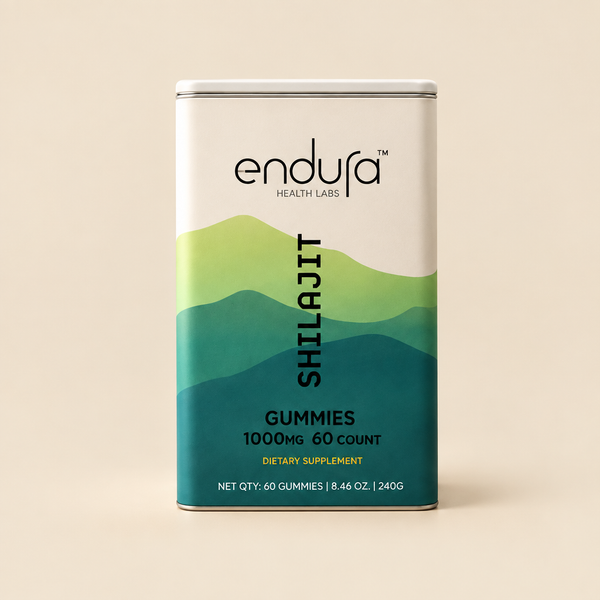
 Endura Shilajit Gummies, 60 countPurified Himalayan shilajit, vitamin D3 and 15 more ingredients in one daily blend. Independently lab-tested in the USA.
See the gummies →
- Independent lab-tested, every batch
- No caffeine
- Vegan, gelatin-free
- 30-day money-back guarantee
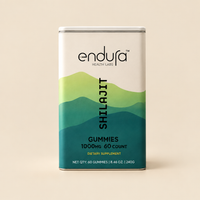
Try Endura for 30 days, risk-free
Caffeine-free daily blend: shilajit, vitamin D3 and 15 more ingredients. Lab-tested in the USA.- First tin $39.99 instead of $44.95 (was $59.99). One per customer, applied automatically.
- Buy 2, get 1 free: 3 tins for $89.95, with free US shipping.
- Monthly plan $39.99 a tin, free shipping, cancel anytime after your first order.
- 30-day money-back guarantee on your first order. Opened tins are fine.
The full label
- Organic shilajit extract (10:1)
- 100mg
- Vitamin D3
- 20mcg 100% DV
- Manuka honey
- 250mg
- Ashwagandha
- 30mg
- Ginger
- 10mg
- Curculigo orchioides (black musli) extract
- 6mg
- Tribulus terrestris (gokshura) extract
- 6mg
- Turmeric
- 6mg
- Chicory root extract
- 5mg
- Burdock root
- 4mg
- Mucuna pruriens (kaunch) extract
- 4mg
- Anacyclus pyrethrum (akarkara) extract
- 4mg
- Cinnamon
- 4mg
- Sea moss
- 2mg
- Black seed oil
- 2mg
- Lion's mane
- 2mg
- Chaga
- 2mg
Calories 22 · Total carbohydrate 6g · Total sugars 4g
Who should skip it
Anyone who is pregnant or nursing, anyone taking prescription medication, and anyone with a diagnosed medical condition should talk to their doctor before adding any supplement, this one included. Shilajit is not a treatment for tiredness caused by a medical problem, it is not a treatment for menopause, and it is not a replacement for anything a physician has prescribed.
Endura offers a 30-day money-back guarantee on a first order: email within 30 days of delivery and the order is refunded. Opened tins are fine and nothing needs to be sent back. Shipping costs are not refunded.
Takeaway
The afternoon wall after 50 has real causes: the body’s daily rhythm, the drop in estrogen around menopause and sleep that gets more fragile. The habits you settle into now are the ones you will be living with at 75.
- notice when your last coffee of the day lands, not just how many you drink
- start the habits that matter for muscle, vitamin D and sleep early rather than late
- talk to your doctor before adding any supplement, especially if you take prescription medication or have a diagnosed medical condition
None of this is destiny, and your afternoons are worth taking seriously.
Get our healthy aging newsletter
Short, practical notes on energy, sleep and aging well, with the research behind them. Tell us what you’re interested in.
Thank you. You’re on the list.
Your privacy is important to us. Includes occasional offers from Endura. Unsubscribe with one click.How we reviewed this article:
Written by the Endura Health Labs editorial team. Every statistic was checked against the study or report it comes from, listed in the sources below. Endura Health Labs paid for this article.
Read next



Our formula includes a small amount (4mg of extract) of Mucuna pruriens, a traditional botanical whose seeds naturally contain levodopa, the same compound used in some Parkinson’s medicines.38 The amount is small, but if you take levodopa, an MAO inhibitor, an antipsychotic or any other prescription medication, or if you have Parkinson’s disease or another neurological, psychiatric or hormone-sensitive condition, talk to your doctor before using this product. It is not a treatment for any condition and must never be used in place of a prescribed medicine.
- Stohs SJ. Safety and efficacy of shilajit (mumie, moomiyo). Phytotherapy Research, 2014;28(4):475-479. PubMed
- Keller JL, et al. The effects of Shilajit supplementation on fatigue-induced decreases in muscular strength and serum hydroxyproline levels. Journal of the International Society of Sports Nutrition, 2019;16:3. Full text
- National Institutes of Health, Office of Dietary Supplements. Vitamin D Fact Sheet for Health Professionals. ods.od.nih.gov
- National Institute on Aging. Vitamins and Minerals for Older Adults. nia.nih.gov
- Drake C, Roehrs T, Shambroom J, Roth T. Caffeine effects on sleep taken 0, 3, or 6 hours before going to bed. Journal of Clinical Sleep Medicine, 2013;9(11):1195-1200. Full text
- Wilson E, et al. Review on shilajit used in traditional Indian medicine. Journal of Ethnopharmacology, 2011;136(1):1-9. PubMed
- Meena H, et al. Shilajit: A panacea for high-altitude problems. International Journal of Ayurveda Research, 2010;1(1):37-40. Full text
- Monk TH. The post-lunch dip in performance. Clinics in Sports Medicine, 2005;24(2):e15-e23. PubMed
- Van Cauter E, Leproult R, Kupfer DJ. Effects of gender and age on the levels and circadian rhythmicity of plasma cortisol. Journal of Clinical Endocrinology and Metabolism, 1996;81(7):2468-2473. PubMed
- Randolph JF Jr, et al. Change in follicle-stimulating hormone and estradiol across the menopausal transition: effect of age at the final menstrual period. Journal of Clinical Endocrinology and Metabolism, 2011;96(3):746-754. PubMed
- National Institute on Aging. What Is Menopause? nia.nih.gov
- Lee J, Han Y, Cho HH, Kim MR. Sleep disorders and menopause. Journal of Menopausal Medicine, 2019;25(2):83-87. Full text
- MacLaughlin J, Holick MF. Aging decreases the capacity of human skin to produce vitamin D3. Journal of Clinical Investigation, 1985;76(4):1536-1538. PubMed
- Volpi E, Nazemi R, Fujita S. Muscle tissue changes with aging. Current Opinion in Clinical Nutrition and Metabolic Care, 2004;7(4):405-410. Full text
- Carrasco-Gallardo C, Guzmán L, Maccioni RB. Shilajit: a natural phytocomplex with potential procognitive activity. International Journal of Alzheimer’s Disease, 2012;2012:674142. Full text
- Saper RB, et al. Lead, mercury, and arsenic in US- and Indian-manufactured Ayurvedic medicines sold via the Internet. JAMA, 2008;300(8):915-923. PubMed
- Tripkovic L, et al. Comparison of vitamin D2 and vitamin D3 supplementation in raising serum 25-hydroxyvitamin D status: a systematic review and meta-analysis. American Journal of Clinical Nutrition, 2012;95(6):1357-1364. PubMed
- U.S. Food and Drug Administration. Dietary Supplements. fda.gov
- Epel ES, McEwen B, Seeman T, et al. Stress and body shape: stress-induced cortisol secretion is consistently greater among women with central fat. Psychosomatic Medicine, 2000;62(5):623-632. PubMed
- Mayer EA. The neurobiology of stress and gastrointestinal disease. Gut, 2000;47(6):861-869. PubMed
- Lovallo WR, Whitsett TL, al’Absi M, et al. Caffeine stimulation of cortisol secretion across the waking hours in relation to caffeine intake levels. Psychosomatic Medicine, 2005;67(5):734-739. PubMed
- Hill EE, Zack E, Battaglini C, et al. Exercise and circulating cortisol levels: the intensity threshold effect. Journal of Endocrinological Investigation, 2008;31(7):587-591. PubMed
- Chandrasekhar K, Kapoor J, Anishetty S. A prospective, randomized double-blind, placebo-controlled study of safety and efficacy of a high-concentration full-spectrum extract of ashwagandha root in reducing stress and anxiety in adults. Indian Journal of Psychological Medicine, 2012;34(3):255-262. PubMed
- US Preventive Services Task Force. Vitamin, mineral, and multivitamin supplementation to prevent cardiovascular disease and cancer: recommendation statement. JAMA, 2022;327(23):2326-2333. PubMed
- Ingersoll KS, Cohen J. The impact of medication regimen factors on adherence to chronic treatment: a review of literature. Journal of Behavioral Medicine, 2008;31(3):213-224. PubMed
- National Center for Complementary and Integrative Health. Ashwagandha: Usefulness and Safety. nccih.nih.gov
- National Center for Complementary and Integrative Health. Turmeric: Usefulness and Safety. nccih.nih.gov
- National Center for Complementary and Integrative Health. Ginger: Usefulness and Safety. nccih.nih.gov
- Avis NE, Crawford SL, Greendale G, et al. Duration of menopausal vasomotor symptoms over the menopause transition. JAMA Internal Medicine, 2015;175(4):531-539. PubMed
- The 2022 Hormone Therapy Position Statement of The North American Menopause Society. Menopause, 2022;29(7):767-794. PubMed
- Greendale GA, Sowers M, Han W, et al. Bone mineral density loss in relation to the final menstrual period in a multiethnic cohort: results from the Study of Women’s Health Across the Nation (SWAN). Journal of Bone and Mineral Research, 2012;27(1):111-118. PubMed
- Greendale GA, Huang MH, Wight RG, et al. Effects of the menopause transition and hormone use on cognitive performance in midlife women. Neurology, 2009;72(21):1850-1857. PubMed
- The 2020 genitourinary syndrome of menopause position statement of The North American Menopause Society. Menopause, 2020;27(9):976-992. PubMed
- National Center for Complementary and Integrative Health. Menopausal Symptoms: In Depth. nccih.nih.gov
- Rosenthal TC, Majeroni BA, Pretorius R, Malik K. Fatigue: an overview. American Family Physician, 2008;78(10):1173-1179. PubMed
- Mirer AG, Young T, Palta M, et al. Sleep-disordered breathing and the menopausal transition among participants in the Sleep in Midlife Women Study. Menopause, 2017;24(2):157-162. PubMed
- Herrick KA, Storandt RJ, Afful J, et al. Vitamin D status in the United States, 2011-2014. American Journal of Clinical Nutrition, 2019;110(1):150-157. PubMed
- Katzenschlager R, Evans A, Manson A, et al. Mucuna pruriens in Parkinson’s disease: a double blind clinical and pharmacological study. Journal of Neurology, Neurosurgery and Psychiatry, 2004;75(12):1672-1677. PubMed
- Marras C, Beck JC, Bower JH, et al. Prevalence of Parkinson’s disease across North America. npj Parkinson’s Disease, 2018;4:21. PubMed
- Mosley PE, Moodie R, Dissanayaka N. Caregiver burden in Parkinson disease: a critical review of recent literature. Journal of Geriatric Psychiatry and Neurology, 2017;30(5):235-252. PubMed
- Happe S, Berger K. The association between caregiver burden and sleep disturbances in partners of patients with Parkinson’s disease. Age and Ageing, 2002;31(5):349-354. PubMed
- Schulz R, Beach SR. Caregiving as a risk factor for mortality: the Caregiver Health Effects Study. JAMA, 1999;282(23):2215-2219. PubMed
- Sörensen S, Pinquart M, Duberstein P. How effective are interventions with caregivers? An updated meta-analysis. The Gerontologist, 2002;42(3):356-372. PubMed
- AARP and National Alliance for Caregiving. Caregiving in the U.S. 2020: Executive Summary. aarp.org
- Parkinson’s Foundation. Helpline: 1-800-4PD-INFO (1-800-473-4636). parkinson.org
- Wilding JPH, Batterham RL, Calanna S, et al.; STEP 1 Study Group. Once-weekly semaglutide in adults with overweight or obesity. New England Journal of Medicine, 2021;384(11):989-1002. PubMed
- Mozaffarian D, Agarwal M, Aggarwal M, et al. Nutritional priorities to support GLP-1 therapy for obesity: a joint Advisory from the American College of Lifestyle Medicine, the American Society for Nutrition, the Obesity Medicine Association, and The Obesity Society. American Journal of Clinical Nutrition, 2025;122(1):344-367. PubMed
Please consult with a physician or other healthcare professional regarding any medical or health-related diagnosis or treatment options. These statements have not been evaluated by the Food and Drug Administration. This product is not intended to diagnose, treat, cure, or prevent any disease. It is not a substitute for medication or other treatment prescribed by a physician or healthcare provider. Individual results vary. Charts show the general shape of published findings and are not personal medical data. Endura Health Labs paid for this advertorial. Questions? Contact us.